


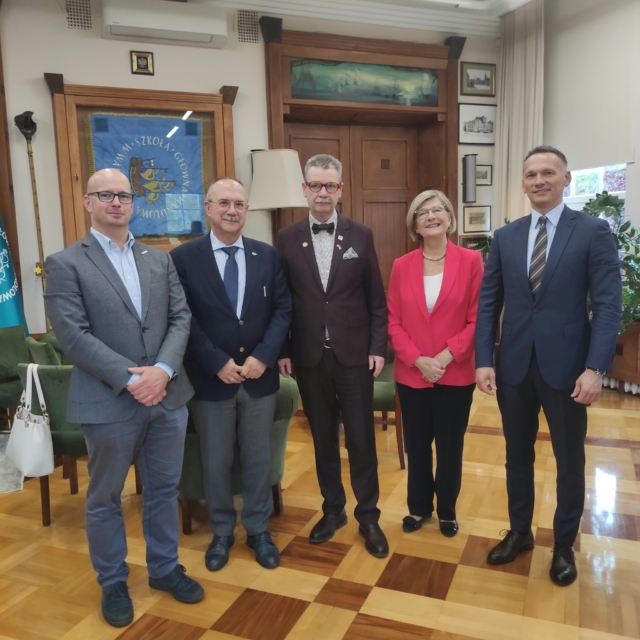
On 8 October 2026, SGH Warsaw School of Economics and the Polish Space Industry Association (ZPSK) signed a cooperation agreement. It was signed on behalf of the two institutions by Prof. Piotr Wachowiak, Rector of SGH, and by Paweł Wojtkiewicz, President of the Management Board of ZPSK, together with Piotr Orleański, Vice-President of the Management Board of the Association.
“Building a strong space sector today requires, above all, close cooperation between science, business and public administration. The agreement between SGH and the Polish Space Industry Association is another step in that direction. For the Space Ecosystem Center, it is particularly important that the skills and knowledge developed at universities meet the real needs of the sector, and that the experience of companies is reflected in the education, research and projects carried out by the academic community. Together, we want to create a space where these two worlds meet much more often,” said Maciej Myśliwiec, Director of the SGH Space Ecosystem Center.
“We believe this cooperation between the Polish Space Industry Association and SGH Warsaw School of Economics will result in a larger pool of future employees whose skills are well suited to work in today’s high-tech space industry. The growth of companies in this sector clearly shows that it needs not only engineers, software developers and precision mechanics specialists, but also lawyers, experts in fundraising and public procurement, and managers prepared to drive business development and the commercialisation of space products and services. The agreement with SGH is a good step towards providing companies with staff who understand the sector and also have solid qualifications in economics,” emphasised President Paweł Wojtkiewicz.
SGH and ZPSK will work together to bring the academic and business communities in the space sector closer together. The cooperation aims to raise the quality of education, align the educational offer with labour market needs, carry out joint research and development initiatives as well as broader business and commercial projects, and improve the qualifications of the space sector workforce.
ZPSK will support the organisation of internships, traineeships and study visits at its member companies for SGH students and academic staff. Its representatives will also contribute their expertise by giving guest lectures, workshops and talks for SGH students. The Association will also help build cooperation and knowledge transfer between academics, students and entrepreneurs, and promote SGH initiatives within the business community.
SGH, in turn, will make its rooms and facilities available for events organised by the Association. It will also consult ZPSK on its reports and studies concerning the space sector, invite ZPSK representatives to seminars, conferences and events it organises on the space sector, the labour market and entrepreneurship, and seek ZPSK’s opinion on its study programmes in light of labour market needs.


